
13 Jun 2026
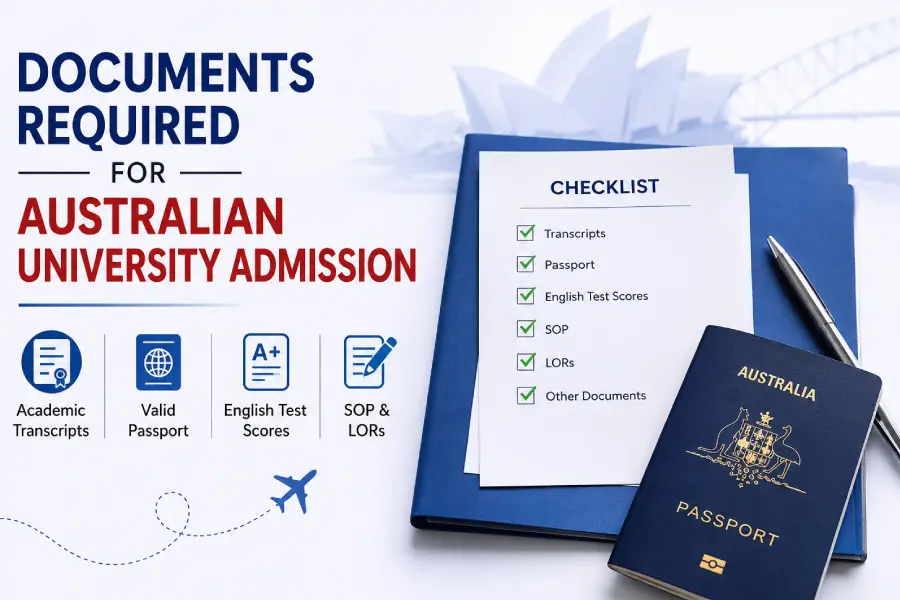
Australia is one of the most popular destinations for international students due to its globally recognized universities, high-quality education system, and excellent career opportunities. Before applying to an Australian university, students must prepare a complete set of admission documents to ensure a smooth application process.
While document requirements may vary depending on the university and course, most institutions request a standard set of academic and personal documents from international applicants.
Academic transcripts and certificates are among the most important documents required for admission to Australian universities. These records help universities evaluate your academic performance and determine whether you meet the eligibility criteria for your chosen course.
Depending on your level of study, you may need to submit:
Universities carefully review your academic history, grades, and subject background
A valid passport is essential for both university admission and the future student visa application process. Most universities require a scanned copy of the passport to verify your identity and personal details.
Before submitting your application, ensure that:
If your passport is due to expire soon, it is advisable to renew it before applying.
Since English is the primary language of instruction in Australia, international students are generally required to demonstrate their English language proficiency.
Australian universities commonly accept:
The required score varies depending on the university, course level, and field of study. Programs such as nursing, teaching, law, and healthcare often have higher English language requirements. Some universities may also offer alternative pathways for students who do not meet the required scores.
A Statement of Purpose (SOP) gives universities a deeper understanding of your academic and professional goals. It allows admissions officers to assess your motivation for studying the chosen program and your suitability for the course.
A strong SOP typically covers:
A well-structured and personalized SOP can significantly strengthen your application and help you stand out from other applicants.
Letters of Recommendation provide independent insight into your academic abilities, character, and potential for success in higher education.
Depending on the course requirements, recommendation letters may be provided by:
These letters should highlight your strengths, achievements, leadership qualities, and academic or professional performance. Strong and relevant recommendations can add credibility to your application and support your overall profile.
Many postgraduate programs, MBA courses, and professional degrees require applicants to submit a Resume or Curriculum Vitae (CV).
A well-prepared CV should include:
The CV helps universities understand your academic journey and professional background beyond transcripts and test scores.
For MBA programs and certain specialized postgraduate courses, universities may require proof of professional work experience.
Supporting documents may include:
These documents help universities verify your employment history and assess whether your professional experience meets the program’s entry requirements. Relevant work experience can also strengthen your application for competitive courses.
Students applying for creative and design-related programs are often required to submit a portfolio demonstrating their skills, creativity, and previous work.
A portfolio may include:
Admissions teams use portfolios to evaluate artistic ability, technical skills, originality, and potential for success in the chosen field.
Although financial evidence is more commonly required during the Australian student visa process, some universities may request proof of financial capacity during admission.
Examples of financial documents include:
These documents demonstrate that you have sufficient funds to cover tuition fees, living expenses, and other study-related costs while studying in Australia.
Certain universities and programs may require additional supporting documents depending on the field of study and level of education.
Because requirements can vary significantly between institutions and courses, students should always review the specific admission guidelines provided by their chosen university before submitting an application.
| Document | Undergraduate | Postgraduate |
|---|---|---|
| Academic Transcripts | ✔ | ✔ |
| Passport Copy | ✔ | ✔ |
| English Test Scores | ✔ | ✔ |
| Statement of Purpose | ✔ | ✔ |
| Letters of Recommendation | Sometimes | Usually Required |
| Resume/CV | Rarely | ✔ |
| Work Experience Proof | Not Usually Required | Course Dependent |
| Portfolio | Course Dependent | Course Dependent |
| Financial Documents | Sometimes | Sometimes |
| Research Proposal | Not Required | For Research Programs |
Submitting a complete and accurate application can help prevent delays and improve your chances of receiving an admission decision quickly. To avoid common mistakes during the admission process:
| Study Level | Common Documents Required | Additional Requirements |
|---|---|---|
| Diploma | Academic transcripts, passport, IELTS/PTE | Class 10 & 12 certificates, personal statement (if required) |
| Bachelor’s Degree | Class 12 certificates, passport, English test scores, SOP | Subject prerequisites, portfolio (for design-related courses) |
| Master’s Degree | Bachelor’s degree, transcripts, SOP, LORs, CV | Relevant academic background, research proposal (for some programs) |
| MBA | Degree, work experience documents, CV, SOP, LORs | Professional work experience, interview (for selected universities) |
| PhD | Master’s degree, research proposal, supervisor approval, LORs | Research publications, detailed study plan, supervisor confirmation |
Even qualified students can face admission delays or application rejections due to simple documentation errors. Paying close attention to the application requirements can help ensure a smoother admission process and reduce the chances of unnecessary complications.
Many applications are delayed because students:
| Timeline Before Intake | Recommended Action | Key Objective |
|---|---|---|
| 12 Months Before | Research universities | Shortlist suitable universities, courses, and intake options |
| 8-10 Months Before | Take IELTS/PTE | Meet English language requirements and improve admission eligibility |
| 6-8 Months Before | Prepare SOP and LORs | Build a strong application profile and gather supporting documents |
| 4-6 Months Before | Submit applications | Apply before deadlines and maximize admission opportunities |
| 2-4 Months Before | Accept offer and arrange finances | Secure admission, prepare financial documents, and plan for visa application |
Varishka writes about the questions students face when planning to study in Australia: Which course is right for me? What will it cost? How do I prepare a strong application? Her articles bring together practical information on universities, scholarships, student visas and life in Australia to help students plan with greater clarity.
Copyright © 2026 Australia Study Consultants. All rights reserved.