
03 Sep 2026
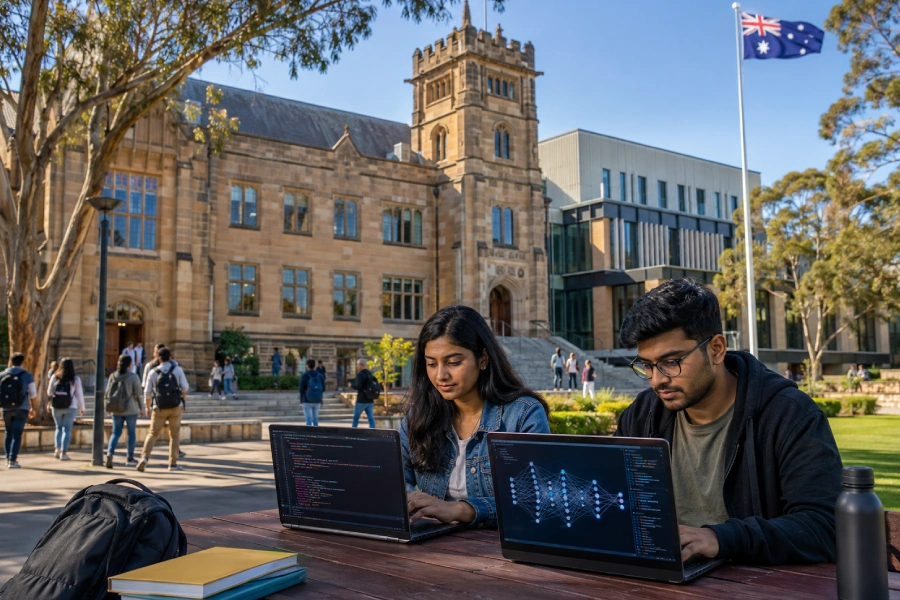
Australia offers postgraduate programmes in computer science, artificial intelligence, data science, cybersecurity, software engineering and information technology.
For Indian students, choosing the right programme requires more than checking university rankings. The course should match your academic background, technical interests, budget and career plans.
Some Australian universities offer a degree titled Master of Computer Science. Others use titles such as Master of Computing or Master of Information Technology while providing advanced computer science subjects.
Therefore, students should compare the curriculum, entry requirements, specialisations and project opportunities instead of relying only on the degree title.
The following universities offer strong postgraduate computing options. This is not a fixed ranking because the best choice depends on each student’s profile and goals.
Schedule a Free Counselling Session
| University | Relevant programme | Location | Typical duration | Best suited for |
|---|---|---|---|---|
| University of Melbourne | Master of Computer Science or Master of Information Technology | Melbourne | 1 to 2 years | Research-focused and experienced computing graduates |
| UNSW Sydney | Master of Information Technology | Sydney | 2 years | Students seeking technical breadth and specialisations |
| University of Sydney | Master of Computer Science | Sydney | 2 years | Computing and non-computing graduates |
| Australian National University | Master of Computing | Canberra | 2 years | Students interested in advanced computing and research |
| Monash University | Master of Information Technology | Melbourne | 1.5 or 2 years | IT and non-IT graduates seeking an applied degree |
| University of Queensland | Master of Computer Science or Master of Information Technology | Brisbane | 1 to 2 years | Computing graduates and career changers |
| Adelaide University | Master of Computer Science | Adelaide | 2 years | Computing graduates seeking specialist and research study |
| University of Technology Sydney | Master of Information Technology | Sydney | 2 years | Students seeking industry-oriented education |
| University of Wollongong | Master of Computer Science | Wollongong | 2 years | Students seeking technical specialisations and value |
| RMIT University | Master of Information Technology | Melbourne | Check selected study plan | Students interested in AI, cloud, data and cybersecurity |
The University of Melbourne offers two relevant postgraduate options: the Master of Computer Science and Master of Information Technology.
The Master of Computer Science is a two-year, research-oriented programme at the Parkville campus. It includes advanced computing study and can support students who may later pursue doctoral research.
The Master of Information Technology is professionally focused. Depending on previous qualifications, students may complete it in one, one-and-a-half or two years. Available study areas include artificial intelligence, cybersecurity, distributed computing and human-computer interaction.
Why Consider the University of Melbourne?Applicants with an established computer science background and research interests may prefer the Master of Computer Science. Those seeking a broader professional pathway can consider the Master of Information Technology.
Visit the official University of Melbourne Master of Computer Science and Master of Information Technology pages.
UNSW offers a two-year Master of Information Technology.
The programme provides advanced IT education with opportunities to study areas connected with artificial intelligence, data, cybersecurity and software systems.
Applicants with a relevant bachelor’s degree generally require an academic result equivalent to at least 65%. Non-computing graduates may be considered through an integrated Graduate Certificate pathway, while maintaining the same overall two-year duration. Mathematics knowledge is strongly recommended.
UNSW listed an indicative first-year international tuition fee of A$63,000 for 2026. Applicants should apply early because some international intakes may reach capacity.
Why Consider UNSW?Visit the official UNSW Master of Information Technology page.
The University of Sydney offers a two-year Master of Computer Science at its Camperdown and Darlington campus.
The programme accepts applicants from different academic disciplines. It combines foundation units, computing core subjects, specialist study and a capstone or research project.
Students can explore specialisations including:
The university’s 2026 international guide listed a first-year tuition fee of A$57,900. The published English requirement was IELTS 6.5 overall with no individual score below 6.0.
Why Consider the University of Sydney?Review the official University of Sydney Master of Computer Science page.
The Australian National University offers a two-year Master of Computing in Canberra. Although the degree title differs, its official field of education is computer science.
The programme covers computing foundations, professional software development and advanced specialist study.
Specialisation options include:
Applicants generally need a recognised bachelor’s degree with a GPA equivalent to 5.0 on ANU’s seven-point scale. Another route may be available to applicants with a GPA of 4.0 and at least three years of relevant professional experience.
ANU listed an indicative annual international fee of A$56,120 for the 2026 programme.
Why Consider ANU?Visit the official ANU Master of Computing page.
Monash University offers an on-campus Master of Information Technology at its Clayton campus.
Depending on previous education, the programme can be completed in one-and-a-half or two years. Applicants without an IT degree may enter the two-year route, while eligible computing graduates may qualify for the shorter route.
Students study programming, databases, computer architecture, networks and software engineering. They may also undertake an industry project or research pathway.
The on-campus programme has February and July intakes and is accredited by the Australian Computer Society. Monash’s separately offered online Master of Computer Science is not currently suitable for international students requiring an Australian student visa.
Why Consider Monash University?Check the official Monash Master of Information Technology page.
The University of Queensland offers both a Master of Computer Science and Master of Information Technology at its St Lucia campus.
The Master of Computer Science is intended for students with previous qualifications in computer science, software engineering or a related field. Depending on prior study, it can take one or one-and-a-half years.
The two-year Master of Information Technology provides a broader route. Its curriculum includes programming, information systems, software development, networks, user-centred design and research.
For 2026, UQ listed an indicative annual international fee of A$58,056 for both programmes. The programmes generally require IELTS 6.5 overall with a minimum of 6.0 in each section.
Why Consider the University of Queensland?Compare the official UQ Master of Computer Science and Master of Information Technology pages.
Adelaide University offers a two-year Master of Computer Science at its Adelaide City Campus.
The programme is designed for students with previous education in computer science, computer systems engineering or software engineering. Its subject areas include artificial intelligence, computer security, networks, data management and software systems.
Students also complete specialist study and an in-depth research project.
The published entry information includes a GPA equivalent to 4.5 on a seven-point scale and IELTS 6.5 overall with at least 6.0 in each skill. The indicative annual international fee is A$57,100.
Why Consider Adelaide University?Visit the official Adelaide University Master of Computer Science page.
The University of Technology Sydney offers a two-year Master of Information Technology.
The programme has Autumn and Spring intakes. It is designed to develop technical and management knowledge through applied study.
Depending on subject availability and the selected study plan, students can explore software development, artificial intelligence, data, cybersecurity and technology management.
Why Consider UTS?See the official UTS Master of Information Technology page.
The University of Wollongong offers a two-year Master of Computer Science with Autumn and Spring intakes.
Students study advanced programming, algorithms, data structures and IT project management. They can complete the general programme or choose a specialisation.
Available specialisations include:
Check the official UOW Master of Computer Science page.
RMIT offers a Master of Information Technology at its Melbourne City campus.
The programme covers programming, algorithms, analytics, cloud computing and data mining.
Specialisation choices may include:
RMIT offers February and July commencement options for this programme.
Why Consider RMIT University?Review the official RMIT Master of Information Technology page.
The following figures are selected published examples. Tuition fees are normally reviewed annually and may depend on study load and subject selection.
| University and programme | Indicative tuition |
|---|---|
| UNSW Master of Information Technology | A$63,000 first-year fee for 2026 |
| University of Sydney Master of Computer Science | A$57,900 first-year fee for 2026 |
| ANU Master of Computing | A$56,120 annual fee for 2026 |
| UQ Master of Computer Science | A$58,056 annual fee for 2026 |
| Adelaide University Master of Computer Science | A$57,100 annual fee |
| UOW Master of Computer Science | A$86,880 total course fee for 2026 |
Requirements vary between universities and programmes. Indian applicants commonly need the following.
Recognised Bachelor’s DegreeApplicants normally require a recognised bachelor’s degree from an approved institution.
Advanced computer science programmes may require previous education in:
Some professional computing programmes accept graduates from unrelated fields and include foundation subjects.
Academic PerformanceMany programmes publish requirements equivalent to an Australian credit average, often around 60% to 65%.
Indian marks are not always converted directly. Universities may consider:
Meeting the minimum percentage does not guarantee admission.
Subject PrerequisitesAdvanced programmes may examine whether applicants have studied:
Students should check subject prerequisites before paying an application fee.
English-Language RequirementsIELTS Academic 6.5 overall with no section below 6.0 is common among the programmes discussed, although each university sets its own standard.
Other accepted evidence may include:
A medium-of-instruction certificate is not automatically accepted by every university.
Indian students may need:
The final checklist should always be taken from the university application portal.
| Specialisation | Main areas of study | Possible career directions |
|---|---|---|
| Artificial Intelligence | Machine learning, algorithms and intelligent systems | AI engineer and machine-learning engineer |
| Data Science | Statistics, databases, visualisation and machine learning | Data scientist and data analyst |
| Cybersecurity | Network security, secure systems, forensics and risk | Security analyst and cybersecurity consultant |
| Software Engineering | Architecture, development, testing and project delivery | Software engineer and solutions architect |
| Cloud Computing | Cloud platforms, distributed systems and infrastructure | Cloud engineer and platform engineer |
| Human-Computer Interaction | User research, usability and interaction design | UX researcher and interaction designer |
| Networks and Systems | Networks, operating systems and infrastructure | Systems engineer and network engineer |
Students should select a specialisation based on the actual subjects and skills involved. Choosing AI or cybersecurity only because it is popular may lead to a poor academic fit.
Our Australia study consultancy can help Indian students identify programmes based on their academic profile, budget and career direction.
Varishka writes about the questions students face when planning to study in Australia: Which course is right for me? What will it cost? How do I prepare a strong application? Her articles bring together practical information on universities, scholarships, student visas and life in Australia to help students plan with greater clarity.
Related Posts:Copyright © 2026 Australia Study Consultants. All rights reserved.